Bullies Are Full Of Fear

People with domination/bully issues typically don't stand up against bullies, they don't stand up FOR other people against bullies, and they attack people who they think are NOT likely to smash them back down.
They attack, disrespect, and "blow off" those they believe to be less powerful than themselves either socially, physically, financially, or politically, and ALSO those who they think will NOT retaliate because of values and ethics.
(That's why they usually attack/blow off/disrespect/slander those in their own family, or those they've gotten to know. They have gauged the person to be either unable or UNWILLING to retaliate against them.)

Those they actually FEAR, however, either socially or physically, they will continue to treat with the most courteous "respect and civility", regardless of the person's actions or attitude.

"Bullies" don't know the difference between respect and fear, or that there even IS a difference.
Most bullies think that the only reason a person does not retaliate against them is because of fear; they don't understand "values" or "empathy", so they can't factor them in.

Tragically, their children often miss out on learning the difference as well, because they're learning from the adults in their lives.
If children don't ever come across adults who are willing and able to guide them in ethics, values, and boundaries, their chances of ever learning are next to nil.

Gossip, Slander, Attention Whores

Whether a negative story about another person is true or not, it's slander if it's used as an excuse to treat the person poorly, and as a way to destroy their reputation in a family, a community, or a business. People who gossip and slander DON'T CARE if something is true or not, and they certainly don't "check their facts". People who trash others behind their backs and who spread rumors are after one thing: ATTENTION. Those who go around calling another a 'drama queen' are the real thing."

Image, Status, Acceptance, and Sexism

Narcissism, Sexism, and Racism go hand in hand because they have the same source:
the desire to be SEEN AS A MEMBER OF A CERTAIN GROUP,
and to be INCLUDED BY MEMBERS OF THAT GROUP.
This is just another IMAGE and STATUS issue.

The boy who used to be your best friend for years stopped hanging out with you... and started hanging out with people you didn't really know, and who didn't include you or act polite toward you.
Ever wonder WHY?
Did you have a serious "falling out", where you did something terrible to him? Or did he just kind of spend less time with you, and more and more time without you, with other people?
Did he act like you were the one who did something "wrong", but offered no valid explanation?

People with Ego and Narcissism issues do this all the time to people they've been friends with for years, family members they used to be close to, and also coworkers, club members, anywhere there are other people.

They suddenly "CHANGE", because their real goal and desire is to be SEEN AS A MEMBER OF A GROUP WITH "POWER", or "POPULARITY", or "ACCEPTANCE".
They will simply DISCARD, shun, "blow off", even slander or ostracize their former "best friend", partner, or family member because that person doesn't FIT IN WITH THIS GROUP.

The person is not the RIGHT SEX or the RIGHT RACE, or even the RIGHT HEIGHT or WEIGHT, or FINANCIAL STANDING.
Or whatever else the group is "all about".

ADDITIONALLY, a "best friend", partner, or family member will be "discarded" and excluded because someone in the GROUP is JEALOUS or ENVIOUS of them, and won't allow their inclusion. So the person trying to be accepted by them "cuts them loose" like extra weight, or TURNS ON THEM like they're suddenly a burdensome growth...

If this has happened to you (and it has happened at some point to MOST OF US, when we didn't know we were "close" to a Narcissist), then consider being "cut loose" a GAIN for yourself.
You didn't know you were being apparently used as someone's SIDEKICK, TARGET, or SPACE FILLER, or STEP STOOL, but now you do, and you are NO LONGER.
Thank the stars, thank the Lord.
Amen.

Above OR Below: Narcissistic Perception

A person who has Narcissism issues thinks in "black and white" terms; everything is ONE THING OR THE OTHER. So their interaction with other people reflects this: To a Narcissist, other people are not variable, changing, growing, autonomous beings who are capable of all kinds of things, no matter who or what they are.

To a Narcissist, people are EITHER:
"higher status" or "lower status".
"Good" or "Bad".
"Weak" or "Strong".
"Correct" or "Incorrect".
"Capable" or "Incapable".
"Smart" or "Stupid".
"Fun" or "Boring".
"Responsible" or "Irresponsible".
"Right" or "Wrong".
"Knowledgeable" or "Ignorant".
"Good" or "Evil".
"Nice" or "Mean".
"Genius" or "Not genius".
"One of us" or "One of them".
"Innocent" or "Dishonest".
"Attractive" or "Unattractive".
"Worthy" or "Unworthy".
"Good" or "Trash".
"Leader" or "Follower".
"Down to earth" or "Stuck up".
"Talented" or "Untalented".
"Above them" or "Below them".

Domination or Submission:
If  a person with Narcissism does not feel like he or she is successfully DOMINATING another person (superior to them, leading them, controlling them), he or she sees that person as TRYING TO DOMINATE and CONTROL THEM.
They are either THE LEADER, or they are THE FOLLOWER, in their minds; cooperation, peer connection, harmony, synchronicity, and kindred spirit is not something they easily understand.
So if a person STANDS UP to their domination, control, and disrespectful behaviors, they will perceive the person as TRYING TO CONTROL, DOMINATE, OR HUMILIATE THEM.

They can't seem to comprehend the difference between a person standing up for themselves against domination and disrespect, and a person trying to assert control over them.

A Narcissist will ONLY "cooperate" as an equal "peer" with a person whom they actually see as "ABOVE" themselves. 

This can also be seen in other illnesses and disorders.
Most children NATURALLY go through this as a normal developmental stage. Children who did not receive enough guidance for various reasons risk getting "stuck" in this way of perceiving themselves and the world.

Narcissist Injury: Humiliation

When a TARGET of a Narcissist does not ALLOW the N. to project inferiority onto them, (treat them like they're less experienced, less intelligent, weaker, less cool, less responsible, less skilled, less deserving of respect), a Narcissist will become ANGRY and INSULTED. This is "Narcissistic Injury", because it's an "insult" to the ego and image the N. is trying create of themselves.

The closest universal thing to Narcissist Injury that most of us may relate with is the time during adolescence when we're trying to build our identities separate from our parents, and our parents treat us like little children in front of our peers. They're ruining our "image" and squishing the perfectly normal, very delicate ego of the adolescent human. They're treating us like the "little kid" version of ourselves, when we want to FEEL LIKE and BE SEEN AS "Grown Up" or "Independent". Narcissists want to be SEEN AS and FEEL LIKE they're a SUPERIOR BEING, so when a person does not allow their disrespectful treatment implying inferiority, the Narcissist feels HUMILIATED, frustrated, blocked, sabotaged, challenged, controlled, and enraged.   

Your Partner's Affair With Money


Post by Red Light Runners Anonymous.

"If you have a partner who is having an affair with money, then you will never be good enough. You will always be in the way. You will never measure up. You will always come second (if you're lucky that is) and certainly never first. Your life will be one big long swim against a relentless and pushing tide. The relationship your partner has with money is the one that has his/her attention, it's the one that catches his/her eye. Eventually s/he will resent you for being in the way, and for getting in between of what s/he really wants. Money. Trying to win the affections of your partner away from their affair with money is like fighting a demon without a face. It's impossible."

Finding Freedom: What Really Happened?

Finding Freedom: What Really Happened?: It has been said that history is written by the winners.  And rewritten ...by politicians and biased motivations.  Did you ever wonder what...

Narcissists With Children

Children suffer the most from exposure to Narcissism.

This statement is likely to trigger defensiveness, denial, or even rage in a person who has Narcissism, because it would cause "Narcissistic injury". Those who have Narcissism can't stand to be exposed for not being "perfect", and especially for not being superior to someone else. Raising, teaching, and influencing children is one of the big image-makers and judgment-markers in our modern society, and therefore can be VERY important to any Narcissist who is using that as a building block for their image and ego.
In other words, whether they're ACTUALLY neglectful or abusive or not is MUCH LESS IMPORTANT to them than being SEEN AS a person who is neglectful/abusive or not.
Their reaction to even the random suggestion that they could be doing something abusive or neglectful toward children would NOT BE "Oh maybe I should take a look at what I'm doing, maybe I should seek some information or advice". Their reaction is more likely to be "That's a bunch of crap! I'm GREAT with kids! I'm a WONDERFUL teacher/parent/coach/counselor/relative! ..." with zero reflection about it.

Defensiveness only, deflection only, humiliation only, anger/rage only.

No wondering about whether they're making mistakes, that they could be doing something better, that they could LEARN something that they don't already know about themselves and their own actions, NO WORRY or CARE about the well-being of the children they're influencing, except for, MAYBE, one of their "favorites".
(Narcissists ALWAYS have "favorite children" and "scapegoated children" when they're around kids, the way other people have favorite foods, and food they don't like).

It is COMMON for a Narcissistic stepparent to try to drive a wedge between a child and the parent.
It is also COMMON for a Narcissistic parent to try to drive a wedge between a child and the other parent's partner.

A Narcissistic parent or stepparent will often even try to drive a wedge between the child and ANY adult or child who the child is connected to in some way.
Especially whom the child responds favorably to, and especially if the adult is a positive influence on the child (and not also a Narcissist), and ESPECIALLY if the Narcissistic parent or stepparent ENVIES the person for any reason, or FEARS that the person will expose the N's agenda or behavior.

It is also COMMON for a Narcissistic stepparent (or parent) to REJECT a child, literally, even try to get the child out of their living space and family, because the child does not PLEASE THEM, because the child's behavior is "difficult", because the child is physically or mentally handicapped in some way, or because the child has been abused or traumatized.

("Stepparent" can also be applied to non-married partners.)

Narcissistic teachers, coaches, counselors, caregivers, relatives, and others who live and work around children will do this as well.
It's about envy, jealousy, control, image, aggression and dominance issues, and self-preservation.

A Narcissistic stepparent, or parent, (or other child-caregiver/worker) will jump to "Disciplining" a child to "remedy" any situation, BEFORE they'll do something else, like normal guidance, spending TIME with a child, doing activities with a child, talking and listening, finding more activities for a child to be involved in, etc.

They will try to "discipline" a child who is "acting out" or seems depressed, INSTEAD OF seeking counseling or changing what they're doing.

They will BLAME A CHILD for all of the child's moods and behaviors that don't please them.

They will BLAME A CHILD for all moods and behaviors EVEN WHEN THEY ARE FULLY AWARE that the child has been through TRAUMA and/or ABUSE.

When they can't "MAKE" a child behave in a way that PLEASES THEM, they will REJECT the child, and then either neglect, abuse (verbally, emotionally, or physically), abandon, slander, or ostracize the child. 

Narcissist adults will REJECT A CHILD who doesn't make them feel pleasant feelings.
They will REJECT A CHILD who is of a RACE or SEX they're biased against, even in their own family.
They will REJECT A CHILD whom they ENVY for any reason
(adults who have 'NPD' can envy anyone, even animals, even prisoners, even slaves, even victims of crime like rape and assault, even people who are seriously ill or injured).

Since people with Narcissism don't have the ability to empathize, or comprehend "cause and effect", or see others as "real" and "valid", they can't understand that children are not the same as adults, and that they are LEARNING "How To Be" in the world, and that they ALL need solid, fair, predictable, empathetic and nurturing guidance and mentoring from the adults around them, WITHOUT bias and prejudice.
It's just not something they can grasp intellectually or otherwise.

Narcissists seem to be fully aware of how painful and life-changing traumatic events can be when something happens to THEM, and how others "should be there for them" and "should be understanding". But when something happens to someone ELSE, even a child, they seem to have no ability to apply any of that in any REAL way to the other person. Worse, Narcissists can either be a direct perpetrator of trauma toward a child, or will ALLOW someone else to bully, abuse, or neglect a child who's supposed to be in their care.


Matching "Vibes" And Emotional Reactions

One of the symptoms that can be seen in both Codependency and "BPD" is looking for others to match one's own emotions about various things.
If Narcissism is present also, then those who don't "match" one's own emotions about something are considered wrong, bad, crazy, and stupid.

For example I've seen the film Titanic, and so have a lot of people. Each person's emotional reaction to the story and the film is unique, and the level of each person's emotional reactions are also unique.
But if I have boundary issues, I might watch for whether other people's emotional reactions MATCH my own.
I might not LIKE a person based on their emotional reaction toward the film; I might judge a person as "Crazy" if their reaction was stronger than mine, or judge them as "Cold" or "Bad" if their emotional reaction was not as strong as mine, or different than mine. I may only "LIKE" people who's emotions about the film were the same as mine.

This could be seen as part of a natural process of relating with others, but the extreme judging of others and specific matching indicates boundary issues.

Teens and young adults often do this with musical genres, sports, and games, and other things as well.
Whoever matches their emotional reactions and feelings toward certain music, toward sports, or certain games is "okay", but those who don't are not accepted in their group.
The less healthy the youth's boundaries are, the more specific the match needs to be for them to accept another youth.
It often shows up as bias toward members of their own sex and bias against the opposite sex. 

When this keeps up in adulthood, there's likely some kind of disorder or illness going on with the person, which could be from trauma.

Right, Wrong, Or True?

If I don't agree with you about something that can not be proven scientifically, it just means that we're probably looking at the same thing from different sides.
What we do next is a choice and an action.
Do I tell you that you're "wrong", even though there's no way to show or prove it?
Do you tell me that I'm "wrong", even though you can't prove it?

If the focus and goal for BOTH of us is really about the object, idea, or concept we're both looking at, then who's "right" and who's "wrong" would not be important at all. 

But if one of us was more focused on dominating the other person, then of course someone being "right" or "wrong" would be the primary focus.

When people are in discussion, the focus is either on the people who are in the discussion, or the focus is on the topic itself. There are specific reasons for each.

When information and exploration is the REAL focus, then there is no arguing, condescension or ego, there is only sharing what one has observed and figured out from one's own point of view, and adding that with what others have observed from their own points of view. Like adding together small pieces of a larger puzzle.

Argument, countering, insult, condescension, and hostility means someone is having an emotional reaction, is emotionally invested, and wants to be "right" or wants another person to be "wrong".

If every person can only see one color in a spectrum, then the only way to find out what a spectrum looks like is for everyone to tell what they see, and for everyone to listen. There are no right or wrong colors in a rainbow. 
Logical Fallacies: Ad Hominem

Preventing Being A Target

There is no way to prevent future Narcissists from seeking out targets and ending up in their "sites". They exist, they're out there. They're often the very people who knocked on the door and pretended to be a friend, or the people who had volunteered to help or care for us.

But what we CAN do is heal ourselves, and stop beating ourselves up for missing the flags.

One of the things that we can watch for is THEM approaching US. When is the last time you were the one who initiated first, or further contact, friendship, relationship, or business with a person who turned out to be abusive, manipulative, slanderous, traitorous, or a con artist?

Be Careful Of Narcissists Using Their Own Label To Accuse Or Slander

It's not uncommon for a person who has Narcissism themselves to put the "Narcissist" label on another person and "condemn" them for it. The label of "Narcissism" can be used as a weapon just like any other label that people use to hurt, reject, or slander another person.
Non-narcissists don't seek to reject or destroy others, and most non-narcissists tend to look not for reasons to judge others negatively so they have an excuse to discard or crush them, but for reasons to judge others positively and excuse their human "flaws".

Narcissists, however, do that all the time: seek out reasons to reject or hate another person.
They'll even BAIT another person to get them to reveal things about themselves and their lives so that they can judge them negatively for it, use what they say as "evidence" and ammunition against them.

They're addicted to feeling superior, self-righteous, innocent, and either being The Hero or The Victim (the Knight or the Damsel, the dragon-slayer or the fearful peasant, the Savior or the one who needs to be saved; it's about the starring role in the 'story'.)

Having human "flaws", making mistakes, expressing emotions, displaying confidence, doing what one is passionate about or is good at, and not being socially perfect is not being a "Narcissist", and if it is, then every human alive or dead needs to line up and get stamped with a big red "N".

Beware Of Anti-Animal-People

Beware of humans who don't "get" love, companionship, and respect for animals.
It's not necessarily a Narc-flag, and there are people who are full-blown Narcissists who are "animal people".
But it's something to be aware of. They may lack empathy.

They may also be trying to prove their dominance and superiority to other humans by displaying "indifference" toward animals.

Also, people who don't "get" kids.

Those who have contempt for children or animals should be flagged.

Those who show bias for GIRL children over boys,
or BOY children over girls, or who show RACIAL bias toward children also warrant close attention and caution.

Willful Blindness

A key trait of Narcissism is willful blindness to one's own contribution to a negative situation.

Self-reflection and admission of one's own flaws in either action or character is too painful, too humiliating, or too terrifying for a person with Narcissism, whether they actually have the "disorder" or they're stuck there for self-preservation.

Hating a person who they've had some conflict with, who they envy, or who they've hurt or betrayed; trying to dump all blame on another person; trying to make another person submit to their control with intimidation, threats, meanness, or humiliation; hating a person who disagrees with them or doesn't give them something they want; excluding, disrespecting, and denying a person, and expecting them to accept the treatment because of their apparent "inferiority"; hating a person because they stood up for themselves or for someone else; having no interest in the well-being of the other person; wanting to see another feel pain or be crushed; trying to hurt or destroy another person's social or business reputation; and trying to inflict pain, suffering, and problems upon another person are all symptoms of Narcissism.

Fatal Error

Relationships And Harmonizing Frequencies


Regarding kindred spirits, parent/child relationships, and romantic partner relationships, a person who is trying to have a relationship with a person with Narcissism can be trying to do something that's not possible, because of the way relationships work.
If you're an artist, and you meet someone who's also an artist, the most obvious thing about your meeting is that you have ART in common. So in a simplified way, that would make you "kindred spirits". You're both artists, you both enjoy making art, you both "get" art, and you both "get" making art.
You are have matching "frequencies"; your vibrations align with one another, so like two notes played on a piano, you'll match tones, or make harmony.
But... if ONE of you is an artist because of an additional reason, such as ego, elitism, being seen as "unique and special" and/or being "number one", then your frequencies WILL NOT align, and you will not be "kindred spirits". You're not making art for he same reasons, and you're not on the same page.

If you are trying to "match frequencies" with someone who is an artist, but their agenda is not just "making art" but being the "Number One Artist", that means they don't want to make art alongside of you, next to you, or with you; their agenda is about being BETTER than you. Competing against you. Beating you. "Winning" against you.
So if you try to match frequencies with someone who is trying to be "Number One", then YOUR agenda would have to match THAT, "trying to be Number One". Which means you can't actually be a kindred-spirit-artist with them, you can only be kindred spirits in COMPETING and trying to "WIN", trying to beat the other one.

Examples of this in the arts are more easily seen because of the nature of the arts-world having "spotlights" everywhere. But it's found anywhere there are humans, and humans with Narcissism.

It's natural and normal for a child to match frequencies with their parent, to be "like Dad" or be "like Mom".

So, what happens when "being like Dad" means being the only person in the house who's capable of driving a car properly?
A child who tries to be like that Dad will try to match that frequency, "I am the only person in the house who's capable of driving a car properly", which puts them at DIRECT ODDS with their father. So now there are TWO people in the house who are competing for the spot of "I am the only person who drives right".
If the Dad's frequency was "I'm a good driver", then that would be something the child could match. They could both feel like they're "good drivers" together.
But if it's "I'm the ONLY good driver", then it's not possible for someone to be a kindred spirit and match that frequency WITH him. They can't BOTH be the "ONLY good driver" in the house. It's automatic competition, and not the healthy kind.
The Dad is setting the child up.
In order to feel "matched" to Dad, which is normal, the child would have to AGREE with the agenda. The child would have to ADAPT the belief that Dad is the "ONLY capable driver" in the house.
That means that the child CAN NOT ALSO believe that Mom is a capable driver, nor that older Brother is a capable driver, nor that older Sister is a capable driver. When the child learns how to drive, in order to stay "matched" to Dad, the child has to believe that he or she ALSO CAN NOT be as capable as Dad at driving.

What happens to the child who is the opposite sex of a parent who's agenda includes being superior because of their sex?
How does that child MATCH the frequency of their parent, "be like them", without developing self-loathing, and developing bias AGAINST the child's own gender?
So Douglas loves his Mom, and wants to be a good, responsible person who is good at her job of being a Pediatrician. Douglas is proud of his Mom and wants to be like her. However, his Mom feels that she is a good Pediatrician because she's female. She feels that she's responsible and nice because she's female, and that males are not naturally good at any of that. So, what happens to Douglas when he keeps trying to match his frequencies to his Mom's, and learn from her, and "be like her"?
In order for him to MATCH with her, he would have to adapt her beliefs about males being naturally less capable, or incapable, of being all the things that SHE IS. So Douglas would have to AGREE that males, like himself, are inferior to females, in order to match with his own Mom.

Gloria's Dad is a horse trainer, and is a kind, upstanding, strong person who everyone seems to respect. Gloria wants to be just like her Dad. However, Gloria's Dad attributes all of his abilities and "good person" traits to being a MAN. So, like Douglas, she tries to match her frequency with her Dad, and be "just like him", but he consistently shuts her out, shuts her down, and humiliates her with bias and rejection. Kind, upstanding, and strong? Not so much... unfortunately for Gloria. Her Dad is not "all that", but she finds out the hard way, by being rejected and scorned by him when she tries to bond with him and learn from him, because of his ego-identity issues.

To take this another step, this is ALSO seen all the time with parents who are biased toward one sex or the other, REGARDLESS of their own sex. So a Mom can be biased toward males, and a Dad can be biased toward females. So in order for their male or female children to match their parents' frequencies, the kids would need to adapt their parent's biases. Those biases would be either FOR or AGAINST themselves, AND their siblings, AND one of their parents, AND every other human being in their life.

This happens all the time in "romantic partnerships" where one person is trying to be a kindred spirit with the other, and match their frequency, but the other person didn't really have that frequency in the first place.
For example, Peggy and John have software programming in common. So John thinks it's so cool to have met someone who understands what he does, and "gets" his point of view and way of thinking. He thinks he's met a kindred spirit; they even program all the same languages. But Peggy's point of view is not the same as John's; she does enjoy programming, but her main agenda is believing herself to be smarter than other people; programming is just one of the things she uses to "prove" that.
John keeps trying to share thoughts, observations, and jokes about programming with Peggy. But time after time, he feels shut down and shut out, because Peggy's reactions to his sharing attempts are often curt, condescending, and even angry.
She is NOT interested in "sharing" being a programmer WITH John, she's interested in being SUPERIOR to John, and to other people. That's her agenda, not a "passion" for programming. She's good at it, so John mistook her skill for passion.

The truth is, John and Peggy have very little in common. They're both skilled at programming, and they both like Kentucky Fried Chicken and Starbuck's coffee, but there's not much more; their "frequencies" don't match, and CAN'T match, because Peggy's agenda is about being "better than" other people.

If you hit a piano key and make an "A" ring out, and then a "C" with it, they sound like a chord, which sounds like harmony, because their frequencies resonate with one another. If you hit two "A" keys, they resonate with one another as the same note, although one is a higher frequency and one is lower. But if you hit an "A", "B flat", and a "B" at once, it doesn't sound nice, it sounds "off", and dissonant. It doesn't match, it doesn't resonate, it doesn't harmonize.
~Also, if you hit an "A", which piano key could you hit to make a "superior" note? If someone is trying to make another note be "superior" to the "A", it's a futile attempt, there are no "superior" or "inferior" notes. They're all valid and real, as one to another. A person who is trying to make one note "superior" to another is probably trying to play one LOUDER than the other, and drown the other out. Which is just "louder", not "superior".

If we take John and Peggy and turn them into a pair of musicians instead of programmers, or a pair of Chefs, a pair of animal rescuers, a pair of magicians, a pair of PARENTS, where one is into the activity itself and has a passion for it, but the other one is using the activity as a way to paint their image and/or be 'superior' to others, it becomes evident why FRICTION and dissonance happens when it looks like there should be flow, cooperation, and harmony.
~~~

This also happens when two people come together but have different agendas about the relationship itself. For example Scott and Susan meet at a friend's party. Susan finds Scott funny and interesting, and intelligent. She's excited that she has found someone with the same dry wit and lively sense of humor, and who also loves similar music, the outdoors, and animals. She thinks she's found a kindred spirit. She and Scott "hit it off", and start dating.
What Susan doesn't know is that Scott's attraction toward her has nothing to do with her sense of humor, her musical taste, her love for animals and the outdoors. Scott's attraction is simply physical, and he also thinks that Susan will make him seem more important if she's his girlfriend.
Susan does not know that Scott only likes the same music she does because he thinks it's "GUY" music, not because he "gets it" on a deeper level.
She doesn't know that he plays an instrument because he thinks it makes him "cool", not because he has a passion for music.
Susan also doesn't know that Scott exaggerates his "love" for animals because he knows it makes him sound caring.

Susan is dating Scott because she thinks she has found a kindred spirit.
Scott is dating Susan because he wants to have sex with her, and he wants to be seen with her, and because he thinks that if he's in a relationship with a female, he gets to be the "boss". He doesn't care at all about Susan's humor, preferences, passions, abilities, or goals, and he never did; he wasn't looking for a "peer", a "friend", or a "kindred spirit". What he cares about is that she'll keep giving him what he's trying to get from her. 

They aren't kindred spirits at all. But Susan won't know that until she finds out the hard way, after spending more time with Scott.  When Susan expresses the way she sees something, her point of view, Scott gets annoyed or dismissive, which confuses Susan because she thought they were "on the same page", since Scott was acting like they were.
When Susan tries to find out what's going on by asking questions, Scott becomes defensive and tries to "shut her down".
When Susan suggest that they might need to find better ways to communicate and be a "couple", Scott gets annoyed, angry, and cold, because he doesn't WANT to be that kind of couple, he never did. He just wants a human of the opposite sex who will fill the expectations, wants, and desires he has.

(Further, Scott thinks that what he wants is "simple", and that since he doesn't physically assault Susan, he's doing nothing "wrong".) 

Scott and Susan have very little in common, and therefore Susan will not find a "matching frequency" with Scott.
UNLESS...
Susan changes HER OWN frequencies to match Scott's frequencies.
Such as... adapting Scott's belief in his superiority and entitlement over Susan.
But then, Susan will have changed who she is as a person, and Scott will probably reject her for that.

Kindred Spirits, Matching Frequencies, Creating Resonance and Harmony are part of the natural world, and are what creates and builds connections. We don't need to be a clone of another person to resonate and harmonize, and it's good to learn from others who have different points of view than ourselves.
But when certain key things are fundamentally different, and automatically create competition about WHO is "more valuable", and create rejection, then we don't get RESONANCE, we get dissonance.

Name Dropping

Since they think they already know a lot of information about other people that they know, meet, or see, Narcissists will often accuse another person of lying, making things up, and exaggerating or embellishing when a person says/does something that doesn't line up with the N's assumptions about them.
Whether it's something about the person's past experiences, something having to do with their skill set, their knowledge or ability, achievements, or other people they're connected to in some way, a Narcissist will assume they're "making it up" if what they're saying does not line up with the N's assumptions about them.
(The Narcissist can't be wrong, and already has a picture of the person painted in their minds, so anything that doesn't line up with THEIR picture of the person must be wrong or untrue.).

If someone else (especially a target) were to tell a Narcissist something that another person has done or said, the Narcissist will ONLY BELIEVE THEM if whatever they say lines up with what they already believe to be true.
For example if a Narcissist thinks Carl is a "good person", then if someone complains about Carl being mean to them, or doing something unfair or shady, the N. won't believe it, and will argue that it isn't true. Their defense of Carl isn't really about Carl, it's about their own picture of Carl needing to be RIGHT.
On the other hand, if they think Carl is a "lazy" or "stupid person", then when someone tells them about Carl's achievements, accomplishments, and success, they will be dismissive and negative about it, or act utterly shocked, or refuse to believe that it's true. Again, it's not about CARL, it's about the N. needing to be RIGHT, and needing the picture they have painted of Carl to stay the same. Carl has to either be one of the good people that they're associated with, or Carl has to be some kind of 'loser' that they can compare themselves to and feel superior to.

"Name dropping", for example, falls in this category.
While a person with Narcissism will "name-drop" in order to make themselves sound associated with another certain person and make themselves seem more important, they will assume that someone else (especially a target) is making things up or embellishing ("name-dropping") if they mention a connection with a person who's famous, wealthy, or in authority.
For example when Jay, who has Narcissism, tells about his job in California, he will keep mentioning famous people he worked with, worked for, or happened to cross paths with, and he'll say their names like he's close friends with them. He's "name-dropping", not just relating his experiences, because he's trying to create the impression that he's "in with" those famous people, and that the person he's talking to is NOT, and that makes him more important (in his mind).
However when Sally is talking about her job, she also mentions famous people, because they were part of the experience she's telling about. She's relating what actually happened, but she's not mentioning their names in order to make herself sound more important. She might be excited about working with them, or she might have found some of them difficult, but that's part of her experience she's telling about.
~ JAY assumes that "name-dropping" is what she's doing,  because that's what HE does.


Sonya and Rachel both have relatives who are famous and "powerful". But the way they mention those relatives are quite different.

Sonya seems to find a way to "drop" their names into conversation in a subtle way, and she does it often, so that most people who know her also know about her relatives, and remember WHO they are and what the relationship is.
She'll say something like "oh I'm so tired..." then the other person will say "how come?" she'll answer with "oh, well I just got back from helping my cousin Oprah help her clean out her closet." then, of course, the other person will say "Your cousin Oprah? THE Oprah?" and then Sonya will say "yeah, that's the one... she needed my help to figure out how to arrange her shoes, I'm always going over there to help her... she can be so sweet, but she's such an airhead sometimes..."

~
Subtle... "I was doing this mundane, annoying thing... and oh yeah I happened to be doing that with my famous, important relative...oh what a bother that was... she's always bugging me..." or "Oh yeah, we all went to the park and had a great time... when my (famous/powerful relative) ate a tuna sandwich, he didn't really like it, so he said '(yah yah yah)'..." She talks about the famous relative not liking the tuna sandwich, but she doesn't mention her Aunt who's not famous slipping in the mud and fracturing her wrist, or her younger sister's new puppy, or her cousin's announcement about his engagement, or even her daughter getting chased by a roaming, apparently vicious dog.

Name-dropping is when a person "SLIPS IN" other people's names while relating random stories and experiences, for the purpose of making an association between themselves and the "important" person. It seems to work pretty well on a lot of people; it's one of the tools in many Narcissist's toolbox.
~

Rachel's famous or "powerful" friends and relatives come up in conversation when it's actually relevant, just like any non-famous person would. Also, if the subject IS about them, specifically, or about having famous relatives.
For example, Rachel might say "I'm so tired", and the other person might say "how come?" and she would reply "I was just doing a lot this week, and I helped my Uncle clean out his closet."
For Sonya, saying "I'm so tired" was BAIT to get the other person to ask "How come?" so she could say "my cousin Oprah". But Rachel was just stating that she was tired. If the friend does not ask any more questions about cleaning out her Uncle's closet, it probably won't occur to Rachel to tell the person WHO her Uncle is. OR, Rachel might tell the person who her Uncle is, because she might feel like it's inappropriate NOT TO, if the person is a friend. (Imagine finding out after a couple of months or years that a friend of yours was Frank Sinatra's niece, or Barack Obama's first cousin, but she never mentioned it to you. It can feel like she was withholding the information on purpose from you, and can seem cliquey and elitist, or just weird.)

Since Narcissists use "name dropping" as a tool for tweaking their image, they tend to project that onto others. So when another person mentions working with someone famous or "powerful", meeting them, running into them, being friends with, or being related to someone famous or "powerful", a Narcissist will often immediately assume that's what they're doing.
That's the reason THEY would mention association with a famous/powerful person, so that's what they project onto the other person, automatically.

"Megan is always talking about her brother, that famous actor... she thinks she's so great..."
It doesn't occur to them that Megan would "always talk about her brother" if he was digging ditches or sweeping stables, because he's her BROTHER, and they're close; she's always talked about him a lot. But whenever she mentions his name, the listener doesn't think "Megan's brother".. the listener thinks "That Famous Actor", and feels envious and jealous, and also intimidated. So the listener projects those feelings onto Megan, as if she's the cause of those feelings.

Appearances, Body Parts And Narcissism

Fixation and focus on the physical world, including the human body, is common in those who display Narcissism traits.

Focus and attention on the "physical", as it appears to them, and as it appears in the current moment, with little or no understanding that there is any more to something or someone than what they can perceive right here and now with their five senses (especially vision).

This can also be seen in other forms of illness, "disorder", and in some who are immature either because of actual chronological age, or for reasons of a developmental delay.

Those who have Narcissism tend to be fixed on physical things in the world, other people, and themselves. The physical body and appearance of another person, and what they look like right now, in the present moment, is where their attention and focus is, and that takes up MOST or ALL of their attention and mental processing.

The physical world takes up most (or all) of their attention, so there is very little intellectual processing regarding things they can't literally SEE, or hear, smell, taste, or touch.
They have a hard time with comprehending that there is MORE than they can see, or hear/smell/taste/touch, and that there are things about what they're observing that they don't know or understand.


Many people with Narcissism can be heard speaking frequently about appearances, human bodies and body parts, clothing, and bodily functions.


They can often be heard talking about their own appearance, bodies and bodily functions, as well as that of other people.
They are often heard commenting and discussing their own bodies and whether they are attractive or not, and ALSO very frequently commenting on other people's bodies, faces, hair, clothes, and "attractiveness" or "lack thereof".


Many who have Narcissism tend to be fixated on race and ancestry; their own, and that of others. They tend to identify people, including themselves, as a member of a certain race or ancestry as if that "sums up" who and what the individual IS.


GENDER


Most people with Narcissism seem to be fixated on which sex/gender they are, and others are as well. They tend to refer to other people and themselves in female or male terms instead of "human", or gender-neutral terms, because of this body fixation.


Additionally, most (not all) Narcissists are very biased toward one sex and against the other, because of their desperate emotional desire for superiority over others.

This desire to "prove superiority" of one sex, or "inferiority" of the other sex, is not about science, because science doesn't CARE about "superiority" or "inferiority". It's about a person's emotional issues.

REAL science has NO desire for one or the other, NO emotional or personal investment, NO resentment, NO expectation, and NO personal issues; REAL science does not assess something as "better than", it only describes factual observations SO FAR, and REAL science knows it DOES NOT KNOW all of the information, or even most of the information.
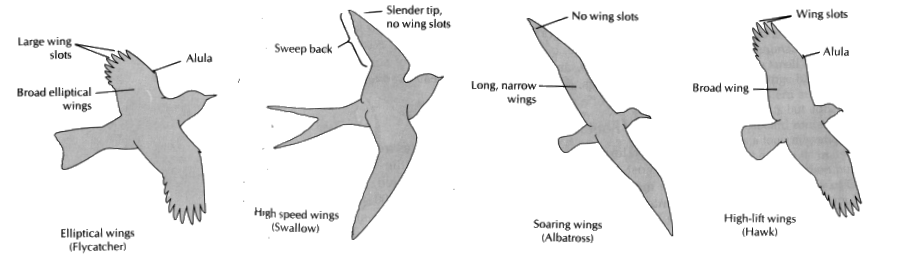
~A person who happens to be a "scientist" might INSERT his or her own opinions into a factual observation, but that's not "science", that's personal opinion. For example Dr. Jacobs might call the flight of an Albatross "better" than all other birds, and Dr. Abrams might call the flight of an Eagle "better" than all other birds. That's not the SCIENCE of it, those are their own personal opinions, OUTSIDE of the actual "science".


It's important to understand that it doesn't matter WHICH SEX a Narcissist may insist is "superior", NOR which sex THEY are.

Even a person who is born with both biological sexes (referred to as "hermaphrodite") can develop Narcissism and superiority and bias issues for or against one sex.


Sexism (bias for against males or females) is just another form of "US" vs. "THEM"; seeking excuses to disrespect, exclude, and treat an entire grouping of humans without integrity.


Humans with Narcissism will try to use ANY physical difference between human beings in order to claim to be a member of a "superior" group of humans. Sex is just one of those differences, just like race or weight.

Many people with Narcissism can be heard and seen "proving" what sex they are with their appearance, body language, speech, actions, behaviors, and even apparent overt displays of emotion (such as making obvious sounds and movements of 'anger', or overt displays of 'fear', depending on what they think their sex is supposed to look and sound like). This is behavior that's seen in children who are learning about identity, but it's a stage of maturity, not a "destination".

Many are also fixated on OTHER people's gender, and on whether another person is  DISPLAYING behaviors and appearances that the Narcissist thinks they "should" because of their gender.

Narcissistic people are often highly focused on (some can have obsessions with) bodily functions, their own and others, such as physical exertion, eating, sweating, spitting, digestion, urination, defecation, five senses, pain, muscles and muscle strength, abilities of the body, excretions (earwax, oil), and things related to sex.

The fixation on the physical world tends to LIMIT their ability to "measure" themselves, and judge others.
For example a person with Narcissism will often actually assess a taller person as more intelligent and more capable than a shorter person, with NO information other than appearance.
They will often actually assume that a larger person has more resources than a smaller person:
more money, more family, more friends, and more possessions.
Most people are aware of the common cultural myth about "ALL women preferring a man with a large penis" and "ALL men preferring women with large breasts". This is only true for those adults with certain forms of Narcissism and other specific illnesses; only a person who is fixated on human body parts and sex would actually "prefer" or "reject" another PERSON based on the size of one of their body parts, including parts that are related to sex. Non-narcissistic and mentally healthy people develop romantic relationships with people they LIKE and enjoy spending time with, and ALSO feel attraction to, so eventually if the relationship develops more deeply, they may take it to a sexual level. But the sexual intimacy is because of the relationship becoming more intense and intimate, not the other way around.
(The relationship is not because of the sexual attraction, and especially not solely because of the sexual attraction, especially in adults: If and when that does happen with a non-narcissist, it's a boundary issue that people with Codependency or BPD may be dealing with, often from trauma.)

Since the physical world takes up their awareness, they can be seen to have a very low ability to comprehend abstract things about what or who they're looking at.

Since it's very difficult for them to process or deduce in the abstract, they tend to make ASSUMPTIONS about what they see, hear, smell, taste, or touch. They think they know a great deal of information about whatever and whoever they're observing.


They tend to BELIEVE their assumptions with little or no doubt, and little or no speculation.
They tend to think that their ASSUMPTIONS are actually clever and logical assessments.

Since it's difficult for them to mentally process that that they DON'T KNOW the "whole story" from what they are seeing in front of them, (or hearing, etc.), they ASSUME that they DO KNOW the "whole story", based on the very small and superficial amount of information they are receiving through their five senses.


For example:
A person with Narcissism will see a tall male adult, a total stranger with whom they have NO personal connection to, and immediately notice his body parts, his individual facial features, his hair, shoulders, apparent weight, the length of his arms and legs, the clothes he's wearing, his vocal tone, jewelry, and the way he holds himself.
They will "assess" whether he's attractive or not to OTHERS, and HOW attractive.
They'll assume that they know whether he's heterosexual or not.
They'll "assess" whether or not they would "win" in a test of strength or fighting with him.
They'll think they can tell all kinds of things about his personality, in specific detail.
They will believe they know his level of intelligence, strength, experience, and skill.
They will believe they can tell what his interests are, and what he does for a living.
They'll believe they can tell how much financial wealth he has or doesn't have.
They will even assume that they KNOW whether he's trustworthy or not, even before meeting him or knowing anything about him.

They'll do all this "processing" of this total stranger in their heads, based purely on his body, clothing, and voice. And they'll believe that they're RIGHT, because they can SEE and HEAR him.
They will then treat him according to the character of him they made up in their head, possibly forever. The only thing that will make a dent in changing their assumptions about him, about his  personality and capability, is a noticeable change in his physical appearance.

In other words, they would believe he "changed" drastically if he let his hair grow long and braided it into dreadlocks, even if that was the ONLY thing that he changed about himself.
~~~However, if he were to LOOK pretty much the same, but changed careers, got arrested for selling meth, treated his wife horribly, or discovered a cure for a terrible disease, they would NOT see him as "changed". Those things are too abstract, they're not ON his physical body, so they don't enter into their assessment of his personality and capability. He would still be seen by the Narcissist as basically the "same guy", no matter what he did or didn't do, as long as he LOOKED the same.


Only Men Can Do That; Only Women Understand That

We humans like to set up our world a certain way and then say "That's how it was when I got here!"

If I teach my daughter to cook pancakes but not my son, then which one of them is going to know how to cook pancakes, and which one of them is NOT going to know how?

So, my daughter knows how to cook pancakes, and my son does not.
Does that mean that GIRLS are naturally better at cooking than BOYS?

Um... wait, let me think on that... the answer is a pretty solid "NO".

What it means is: I taught my daughter how to cook pancakes, and I DID NOT teach my son how.
That's all it means. Nothing else.

So when my oil needs to be changed and both my son and daughter are playing in the yard, which one do I call over to "help me"?
Do I call them BOTH over?
If one of them acts like they're not interested, what do I say?
OH, it depends which one...
so if my SON says "Nah, I'm playing ..." I say "Come over here and help me, you can do this. Here, hold this while I do this... here pull this stick out, see the oil on it? See the marks? Now clean it off with this rag, and stick it back in that hole, yup, all the way down..."
and then he says "this is dirty" and I say "Ahh it washes off, no big deal."
and then he says "this is boring" and I say "You'll have to learn to do this when YOU drive this car!"
and then he perks up, since I just told him the car was going to be his someday.

But... if my DAUGHTER says "Nah, I'm playing..." I don't say "Come over here and help me, you can do this." INSTEAD, I say "Playing.. don't you want to learn about cars?" and then she says "Nahh, I'm doing this..." and then I say "Oh, okay..." and then... "Hey Son, why don't you come over here and help me?" To which he replies "Nahh.. I'm playing..." and then I say "Come over here and help me."

It's not about THEM, it's about ME.

Later, someone else comments on my son working on the car with me, and I say, proudly, "Oh yeah, he was all into it!" even though the truth is, he was bored out of his mind until I implied that HE was going to get the car someday. Would I have implied that to my daughter in order to get her interested in working on the car? NOT... because, it's ABOUT ME, not my son, and not my daughter.

Someone mentions that my daughter seemed uninterested in working on the car, and I say "Yeah, she's a girly girl, she likes her dolls.." (Yes, the dolls they were BOTH using in their game of pretend... which is NATURAL, NORMAL, and HEALTHY for all children, female or male.)

WE set up the world the way we want it, and then we shove children into it, whether they like it or not, and then we say "it's just natural"...

Scapegoats And Narcissists

Scapegoating and Narcissism are intrinsically connected.
If one is present, the other is also, even if it's not immediately evident.
Scapegoats are the people who Narcissists pick as a designated "permanent child" in the group, so that there will always be someone to pick on, someone to blame, someone to COMPARE themselves and others to. 

It's important to understand that it's NOT based in REALITY, it's based SOLELY in someone's ego issues: their desire for control and importance, and their desire to avoid accountability.

No matter what the Scapegoat REALLY does in life, they will continue to be treated by the Narcissist and the N's followers as an incapable, childish, silly, unstable person; like a pain-in-the butt tag-along little brother or sister; like the crazy one in the group; like the one who doesn't amount to anything; like the one who's a "burden" on someone else.

ANYTHING that happens between the Scapegoat and someone else will always get blamed on the Scapegoat, no matter what it is.
No matter WHAT it is, literally.

HEALTHY GROUPS DON'T HAVE SCAPEGOATS.

Only groups where some form of Narcissism is present would designate one of their own members as an ego dumping-station for everyone else.

By the time a Narcissist reaches adulthood, they've already had practice with scapegoating someone. The scapegoat was either a family member, or a person in the community.  But usually a family or household member. It could have been one of their parents, a sibling, a cousin, an aunt or an uncle, a grandparent~

Pretty much any member of the family can get scapegoated as long as there are TWO THINGS present:

One, a Narcissist who singles them out;
and Two, other members of the group who allow and go along with the Narcissist's behavior of singling the person out and treating them with disrespect, unfairness, and/or abuse.
.
.